If you’re in SaaS, your inbox and LinkedIn feed are probably overflowing with takes on AI. From ChatGPT to Gemini to Claude, generative AI is reshaping how we create content, service customers, and even how we find information.
This has led to a pressing question from many SaaS leaders: “If people can just ask an AI for answers, do we still need to invest in SEO?”
The answer is a definitive, resounding yes. But not for the reasons you might think.
SEO isn’t just surviving the AI revolution; it’s becoming more important than ever. For SaaS companies, a robust SEO strategy is transforming from a marketing channel into a fundamental business asset—a true competitive moat.
Here’s why.
AI-Powered Search Runs on High-Quality, Authority Content
Think of the new wave of AI Overview and other LLM, not as content creators, but as content synthesizers. They scour the web, ingest billions of pages, and distill the best answers for users.
Where do they get that information from? From websites. From blogs. From knowledge bases and product pages.
If your SaaS company isn’t producing comprehensive, authoritative, and helpful content that demonstrates E-E-A-T (Experience, Expertise, Authoritativeness, and Trustworthiness), you are invisible to AI. You are not a source it can cite. You get zero airtime in the AI-generated answer.
The SaaS Takeaway: Your content is the fuel for AI. By doubling down on deep, problem-solving content that addresses your audience’s pain points, you ensure your brand becomes a primary source for AI systems, driving awareness and authority.
From Zero-Click to AI Overviews: Your Citation is the New Conversion
For years, SEOs debated the impact of “zero-click searches” where Google’s Featured Snippets answered a query without a click-through. The new era of AI Overviews (previously known as SGE) doesn’t just amplify this—it transforms it entirely. An AI Overview can synthesize a complex, multi-step answer, pulling data and insights from a variety of sources to satisfy a user’s query directly on the search results page.
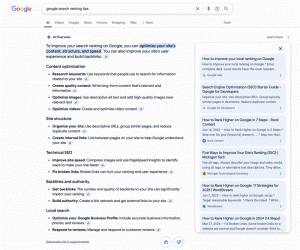
Example of a Google AI Overview citing its sources. Being here is the new pinnacle of SEO success.
This shifts the primary SEO goal from earning a click to earning a citation. For a SaaS company, being one of the three or four sources that Google’s AI cites for a query like “how to build a SaaS content strategy” or “best practices for SaaS onboarding” is a monumental win. It’s a powerful, algorithmically-endorsed stamp of authority that puts your brand in front of a motivated user at their moment of need.
The SaaS Takeaway: Your content must be so definitive and well-structured that it becomes indispensable source material for AI Overviews. The strategy is no longer just about traffic volume; it’s about brand visibility and authority at the very top of the search results, in the most prominent new feature Google has launched in years. A citation is top-funnel brand marketing that you don’t pay for; you earn it with superior SEO and content.
The Battle for Topical Authority is Now a War
In a world of AI synthesis, surface-level content is worthless. AI can generate a generic “What is DevOps?” article in seconds. You can’t compete on volume anymore; you must compete on depth and nuance.
This is where Topical Authority becomes your winning strategy. Google’s algorithms (and by extension, AI systems) map the entire web of knowledge around a topic. They identify which entities are the most authoritative on which subjects.
A SaaS company that owns a specific niche—say, “cloud cost optimization” or “B2B webinar software”—by creating the most comprehensive cluster of content on that topic, will be seen as the authority. AI will learn to prioritize and cite its content above all others.
The SaaS Takeaway: Go deep, not wide. Instead of blogging about every tangential topic, build a content fortress around your core product category. Create the definitive guide, the ultimate comparison, the most detailed case studies. Own your niche completely.
Technical SEO is the Bridge for AI Crawlers
AI models use crawlers not unlike search engine bots to understand your website. If your technical SEO foundation is shaky, you’re not just invisible to Google; you’re invisible to every AI that matters.
Site Architecture: A clear, logical site structure helps AI understand the context and relationship between your pages.
Schema Markup: This structured data is a direct line of communication to bots, explicitly telling them what your content is about (e.g…SoftwareApplication, HowTo, FAQ Page).
Page Speed & Core Web Vitals: A poor user experience signals lower quality, which can influence how AI values your site.
The SaaS Takeaway: Technical SEO is no longer a backend concern. It’s the critical infrastructure that allows both humans and AI to access, understand, and value your content. It’s the foundation upon which AI visibility is built.
The Human Trust Factor Becomes Your Ultimate Advantage
AI might be able to provide an answer, but can it provide trust? Can it provide a community? Can it provide a real-world case study from a customer your prospect can relate to?
People don’t just buy SaaS software based on facts; they buy based on trust, social proof, and emotional reassurance. An AI answer might point them to you, but your website must then close the deal.
Your blog comments, your user reviews on G2/Trustpilot, your detailed case studies, and your authentic brand voice are things AI cannot replicate. They are powerful trust signals that influence both users and the AI algorithms that value E-E-A-T.
The SaaS Takeaway: Use SEO to attract users with top-of-funnel content, but ensure your site is built to convert that interest into trust. Showcase customer testimonials, detailed documentation, and a strong brand story. AI brings the visit; your humanity closes the deal.
Conclusion: Stop Thinking of SEO as Traffic. Think of it as Data
In the AI era, your website and its SEO performance are a data set. It’s the dataset that AI models train on to understand your industry and answer user questions.
If you have a rich, detailed, authoritative dataset (your website), you become an indispensable resource. If your dataset is thin, duplicate, or low-quality, you are irrelevant.
The call to action for SaaS companies is clear: Stop chasing algorithms and start building authority. Invest in content so good that it becomes a primary source for your customers—and for the AIs that serve them.
Ready to future-proof your SaaS SEO strategy? [Book a free SEO audit] with our experts to see if your content is built for the AI age.
